Tablet manufacturing may look straightforward from the outside, but anyone involved in formulation or production knows how sensitive the process really is. Even small variations in material properties or processing conditions can lead to visible and functional issues in the final product.These issues, commonly known as tablet defects, can affect product quality and lead to batch rejection, increased costs, and regulatory concerns.
Understanding manufacturing defects of tablets and how to prevent them is essential for pharmaceutical manufacturers aiming to maintain consistent product performance. One of the most effective ways to control these defects is through the proper selection and use of excipients.
What Are Tablet Defects?
Tablet defects refer to imperfections that occur during the manufacturing process, affecting the appearance, mechanical strength, or performance of tablets. These defects can arise at different stages such as blending, granulation, compression, or drying.
While some defects are easily visible, others may affect internal tablet properties such as hardness, disintegration, or uniformity.In most cases, these issues are closely linked to formulation design and the behavior of excipients used in the process.
Common Tablet Defects in Pharmaceutical Manufacturing
Let’s look at some of the most common tablet defects encountered in pharmaceutical production and what causes them.
1. Capping and Lamination
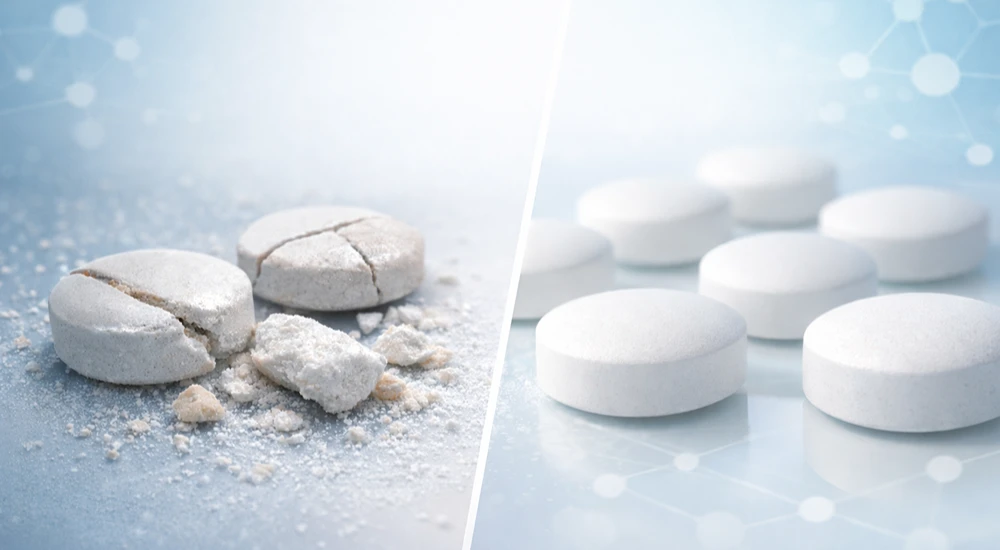
Capping refers to the separation of the top or bottom portion of a tablet, while lamination involves the splitting of the tablet into multiple layers. These defects are often associated with air entrapment during compression or poor compressibility of the formulation.
2. Sticking and Picking
This occurs when tablet material sticks to the punches or dies during compression. It can lead to surface damage and inconsistent tablet shape. Excess moisture or insufficient lubrication are common contributing factors.
3. Chipping and Cracking
Chipping refers to the breaking of tablet edges, while cracking involves visible fractures on the tablet surface. These defects are commonly associated with inadequate binding or improper compression force.
4. Mottling
Mottling appears as an uneven color distribution on the tablet surface. It is often caused by improper mixing of ingredients or differences in particle size and density.
5. Weight Variation
Uniform tablet weight is critical for dose accuracy. Variations occur due to poor powder flow or inconsistent die filling during compression.
6. Hardness Issues
Tablets that are too hard may not disintegrate properly, while overly soft tablets may break during handling. These issues are often linked to formulation imbalance or incorrect compression settings.
Root Causes of Manufacturing Defects of Tablets
Most manufacturing defects of tablets can be traced back to a few core factors related to both formulation and processing. Variations in raw material properties, poor flow characteristics of powders, and inadequate compressibility of the formulation can impact tablet quality. In addition, incorrect excipient selection and differences in particle size distribution may lead to inconsistencies during compression.
Improper process parameters further contribute to these issues, affecting the overall performance and appearance of the final product. These factors highlight the importance of a robust formulation supported by well-characterized excipients.
How Excipients Help Prevent Tablet Defects
Excipients are not just inactive ingredients, they are critical to ensuring tablet quality and performance. The right combination of excipients can help reduce the occurrence of tablet defects.
Binders
Binders improve cohesion between particles, helping tablets maintain structural integrity. This reduces issues such as chipping and cracking. They also enhance the overall mechanical strength of tablets, ensuring they can withstand handling, packaging, and transportation without damage.
Disintegrants
Disintegrants ensure that tablets break down properly after administration. They also help maintain balance between hardness and disintegration. Properly selected disintegrants support consistent tablet performance by enabling uniform disintegration across batches.
Lubricants
Lubricants reduce friction during compression, preventing sticking and picking problems. They also help improve manufacturing efficiency by ensuring smooth ejection of tablets from dies, reducing wear on equipment and minimizing production interruptions.
Fillers (Diluent Role)
Fillers form the bulk of the tablet and play a key role in compressibility and uniformity. One of the most widely used fillers is microcrystalline cellulose in tablet formulation, known for its excellent compressibility and stability.
Microcrystalline cellulose helps create a uniform matrix, which can help reduce the likelihood of defects such as capping, weight variation, and hardness inconsistency. Its predictable performance makes it a preferred choice in many pharmaceutical formulations.
Role of Excipient Quality in Tablet Manufacturing
Even with the right excipient type, quality consistency is crucial. Variations in excipient properties can lead to unpredictable formulation behavior and increase the risk of defects.
High-quality excipients offer:
- Consistent particle size distribution
- Stable moisture characteristics
- Reliable compressibility
- Predictable flow behavior
This consistency ensures that formulations perform the same way across batches, reducing variability in manufacturing outcomes.
Best Practices to Minimize Tablet Defects
Preventing tablet defects requires a balanced combination of formulation expertise and effective process control.It begins with selecting excipients that offer consistent and well-characterized performance, ensuring that the formulation behaves predictably during manufacturing. Optimizing the formulation composition is equally important, as it helps achieve the right balance between compressibility, flow, and stability.
In addition, maintaining consistent raw material quality plays a crucial role in minimizing variability. Careful monitoring of process parameters throughout production helps identify and control potential issues before they impact the final product. Regular quality checks further support this process by ensuring that each batch meets defined standards. By focusing on both formulation design and process control, manufacturers can significantly reduce the occurrence of tablet defects and improve overall product reliability.
Conclusion
Tablet defects are a common challenge in pharmaceutical manufacturing, but they can be minimized with the right formulation strategy. Understanding the causes of manufacturing defects of tablets and selecting appropriate excipients can make a significant difference in product quality and consistency.
With decades of experience in cellulose-based excipients, Ankit Pulps & Boards Pvt. Ltd. supports pharmaceutical manufacturers with high-quality microcrystalline cellulose designed for reliable performance. By ensuring consistent excipient properties and controlled manufacturing processes, the company helps formulation teams reduce variability, minimize defects, and achieve stable, high-performing tablet formulations.
Frequently Asked Questions
What are the most common tablet defects?
Common tablet defects include capping, lamination, sticking, picking, chipping, mottling, weight variation, and hardness issues.
What causes tablet defects in pharmaceutical manufacturing?
Tablet defects are usually caused by poor formulation design, improper excipient selection, inconsistent material properties, and incorrect processing conditions.
How can tablet defects be prevented?
They can be minimized by using high-quality excipients, optimizing formulation composition, and maintaining consistent manufacturing processes.
Why are excipients important in tablet formulation?
Excipients support structure, stability, and manufacturability, helping reduce the risk of defects and ensuring consistent product performance.
How does microcrystalline cellulose help in tablet manufacturing?
Microcrystalline cellulose improves compressibility, supports uniformity, and can help reduce defects such as capping and weight variation.