When working with microcrystalline cellulose grades, it’s easy to assume that all variants behave similarly. After all, they come from the same base material. But in real-world pharmaceutical formulation, the grade you choose can directly influence tablet quality, manufacturing efficiency, and overall product performance.
Many formulation challenges like poor flow, weight variation, or inconsistent tablet hardness can sometimes be associated with selecting an unsuitable MCC grade. This is why understanding the difference between MCC 102 vs MCC 200 is more than just technical knowledge, it’s a practical necessity.
Understanding Microcrystalline Cellulose Grades
Microcrystalline cellulose (MCC) is one of the most widely used excipients in pharmaceutical formulations, particularly in tablet manufacturing. It is widely used for its compressibility, stability, and versatility.
However, MCC is available in different grades, each designed with specific physical characteristics such as particle size, density, and flow behavior. These differences are what define how each grade performs in a formulation.
Among the most commonly used microcrystalline cellulose grades, MCC 102 and MCC 200 are widely preferred due to their balance of performance and adaptability across various applications.
MCC 102 vs MCC 200: Key Differences
Although MCC 102 and MCC 200 belong to the same family, their functional behavior differs due to variations in particle size and physical properties.
Particle Size and Structure
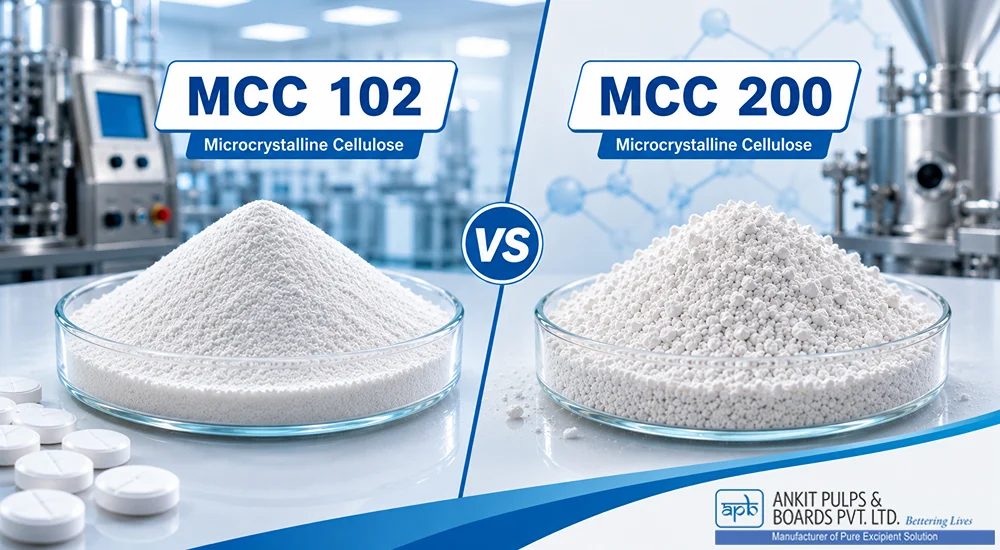
MCC 102 has a relatively smaller particle size compared to MCC 200. This allows it to pack more closely, resulting in better compressibility. On the other hand, MCC 200 has larger particles, which contribute to improved flow properties during processing.
Flow Properties
One of the main advantages of MCC 200 is its superior flowability. In high-speed manufacturing environments where smooth powder movement is critical, MCC 200 can perform more efficiently.
MCC 102, while offering decent flow, is more suited for formulations where compressibility is a higher priority than flow.
Compressibility
MCC 102 is commonly preferred for formulations requiring higher compressibility, making it ideal for formulations that require robust tablet strength. MCC 200 also offers compressibility but is generally selected where improved flow is a higher priority.
How MCC Grades Influence Tablet Performance
The choice between MCC 102 vs MCC 200 directly affects several critical aspects of tablet formulation.
For instance, compressibility impacts tablet hardness and structural integrity. A formulation using MCC 102 may support higher tablet hardness, while MCC 200 may offer better processing efficiency due to improved flow.
Similarly, flow properties influence die filling during compression. Poor flow can lead to weight variation and inconsistent dosing, which are important considerations in pharmaceutical manufacturing.
Even small differences in microcrystalline cellulose grades can result in noticeable changes in formulation behavior, making grade selection a key decision in product development.
When to Use MCC 102
MCC 102 is typically preferred in formulations where compressibility is a primary requirement. It works well in:
- Direct compression tablet formulations
- Low-dose drug formulations requiring uniformity
- Applications where strong tablet integrity is essential
Its compressibility characteristics makes it a reliable choice for ensuring consistent tablet strength.
When to Use MCC 200
MCC 200 is better suited for formulations that demand improved flow properties. It is commonly used in:
- High-speed tablet manufacturing
- Formulations with poor flow characteristics
- Large-scale production environments
Its larger particle size allows for smoother powder movement supporting smoother die filling and powder flow.
Common Mistakes in Selecting MCC Grades
One of the most common mistakes formulators make is assuming that MCC grades are interchangeable. In reality, choosing the wrong grade can lead to several manufacturing issues.
For example, using a grade with poor flow in high-speed production may result in weight variation, while selecting a less compressible grade may contribute to insufficient tablet hardness or compression-related defects.
Ignoring the relationship between microcrystalline cellulose grades and formulation behavior can increase trial time, cost, and production challenges.
How to Choose the Right MCC Grade for Your Formulation
Selecting the right MCC grade requires a balance between formulation needs and manufacturing conditions.
Key factors to consider include:
- Desired tablet hardness
- Flow properties of the blend
- Type of manufacturing process
- Compatibility with other excipients
Rather than relying on assumptions, it is always advisable to evaluate MCC grades through small-scale trials to evaluate suitability for the formulation.
Why MCC Quality Matters Beyond Grade Selection
While choosing between MCC 102 and MCC 200 is important, the quality and consistency of the excipient itself play an equally critical role.
Variations in particle size distribution, moisture content, or manufacturing processes can impact how the material performs. Consistent MCC quality supports predictable behavior, reducing variability in tablet production.
This is why sourcing from a reliable manufacturer is essential for maintaining formulation consistency and meeting regulatory expectations.
Conclusion
Choosing between MCC 102 vs MCC 200 is not just a technical decision, it directly impacts tablet quality, manufacturing efficiency, and overall formulation success. Understanding how different microcrystalline cellulose grades behave allows formulators to make informed decisions and avoid common production challenges.
With a strong focus on quality, consistency, and innovation, Ankit Pulps & Boards Pvt. Ltd. offers a wide range of microcrystalline cellulose grades designed to meet diverse formulation requirements. Backed by advanced manufacturing processes and stringent quality control systems, the company supports pharmaceutical manufacturers in developing reliable and consistent formulations.
Frequently Asked Questions
What is the main difference between MCC 102 and MCC 200?
MCC 102 has smaller particle size and better compressibility, while MCC 200 has larger particles and offers improved flow properties.
Which microcrystalline cellulose grade is better for direct compression?
MCC 102 is generally preferred for direct compression due to its superior compressibility and compressibility characteristics in direct compression applications.
Why do microcrystalline cellulose grades matter in tablet formulation?
Different MCC grades affect flow, compressibility, and tablet strength, which directly impact manufacturing efficiency and product quality.
Can MCC 102 and MCC 200 be used interchangeably?
They are not always interchangeable, as each grade performs differently depending on formulation and process requirements.
How do microcrystalline cellulose grades affect tablet defects?
Incorrect grade selection can lead to issues such as weight variation, poor flow, or weak tablets, affecting formulation performance and manufacturing consistency.
What factors should be considered when selecting MCC grades?
Key factors include flow properties, compressibility, formulation type, and manufacturing conditions.