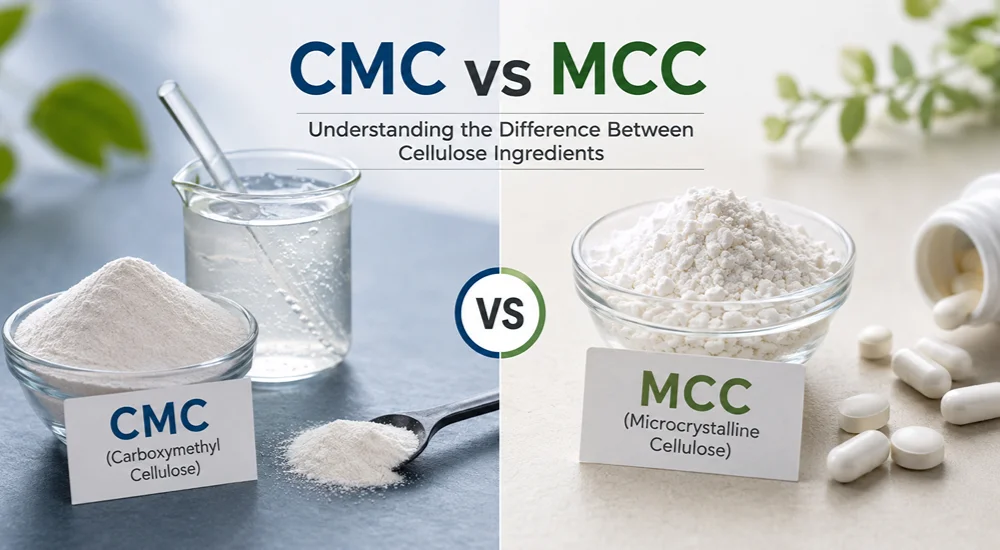
Cellulose-based ingredients play a vital role in modern food and pharmaceutical formulations. Among the most widely used are Carboxymethyl Cellulose (CMC) and Microcrystalline Cellulose (MCC). Although both are derived from cellulose, they have different chemical structures, functional properties, and applications. Choosing the right formulation ingredient depends on whether the formulation requires binding, thickening, stabilization, texture enhancement, or compressibility.
For formulators, manufacturers, and product developers, understanding the differences between CMC vs MCC is essential for achieving the desired texture, stability, processing performance, and product quality. Although these ingredients are often mentioned together, they are not interchangeable.
This guide explores the key differences between MCC and CMC, their unique properties, and where each ingredient performs best.
What Are Cellulose-Based Ingredients?
Cellulose is a naturally occurring polymer found in plant cell walls. Through different processing methods, cellulose can be transformed into specialized ingredients that offer unique functional benefits.
The food and pharmaceutical industries use various cellulose derivatives to improve product performance, enhance stability, and support manufacturing efficiency.
Two of the most common cellulose ingredients are:
- Microcrystalline Cellulose (MCC)
- Carboxymethyl Cellulose (CMC)
While both are derived from cellulose, their structure and functionality differ significantly.
What Is Microcrystalline Cellulose (MCC)?
Microcrystalline cellulose is a purified, partially depolymerized form of cellulose. It is widely used in both food and pharmaceutical applications because of its excellent compressibility, good powder flow, and high tablet hardness.
Key Characteristics of MCC
Microcrystalline cellulose is known for its excellent physical properties, making it a widely used ingredient in both food and pharmaceutical formulations. It is insoluble in water, offers excellent compressibility and flow characteristics, and maintains high physical stability during processing.
Its neutral taste and odor further enhance its versatility, making microcrystalline cellulose a preferred pharmaceutical excipient and functional food ingredient across various applications.
Common Applications of MCC
Microcrystalline cellulose is widely used across both pharmaceutical and food industries because of its versatility and functional benefits. In pharmaceutical formulations, it is commonly incorporated into tablets, capsules, and nutraceutical products to support compressibility and manufacturing efficiency.
In food applications, MCC is frequently used in low-fat dairy products, cheese formulations, bakery products, and processed foods, where it helps improve texture, stability, and overall product structure. Its ability to enhance formulation performance makes it a valuable ingredient in a wide range of applications.
What Is Carboxymethyl Cellulose (CMC)?
Carboxymethyl Cellulose is a water-soluble cellulose derivative produced by chemically modifying cellulose fibers. Unlike MCC, CMC readily dissolves in water and functions primarily as a suspending agent, stabilizer, and viscosity modifier.
Key Characteristics of CMC
Carboxymethyl Cellulose (CMC) is a water-soluble cellulose derivative known for its excellent thickening and stabilizing properties. It helps improve viscosity, supports moisture retention, and stabilizes emulsions, making it particularly useful in liquid and semi-solid formulations.
These functional benefits make CMC a widely used ingredient in food, pharmaceutical, and personal care products where consistency and stability are important.
Common Applications of CMC
Carboxymethyl Cellulose is widely used in applications where consistency, texture, and stability are important. It is commonly found in sauces, dressings, ice cream, beverages, personal care products, and pharmaceutical suspensions. By improving viscosity and helping maintain uniform ingredient distribution, CMC enhances product quality and contributes to a more stable and consistent formulation.
CMC vs MCC: Key Differences
Although both ingredients originate from cellulose, their behavior in formulations is very different.
Solubility
One of the biggest differences between CMC vs MCC is solubility.
CMC dissolves in water and forms a viscous solution. MCC remains insoluble and acts as a structural ingredient rather than a thickening agent.
Functional Role
CMC primarily works as a thickener and stabilizer, helping improve viscosity and maintain product consistency.
MCC, on the other hand, functions as a binder, filler, and texturizer, providing structure, stability, and support in food and pharmaceutical formulations.
Processing Performance
CMC influences viscosity and flow characteristics in liquid systems.
MCC performs best in dry powder formulations where compressibility, flowability, and structural integrity are important. CMC performs best in liquid and semi-solid systems where viscosity control and stabilization are required.
Application Focus
CMC is generally selected when viscosity control and stabilization are required.
MCC is preferred when formulation strength, texture, and compression performance are important.
| Property | MCC | CMC |
| Full Name | Microcrystalline Cellulose | Carboxymethyl Cellulose |
| Water Solubility | Insoluble | Soluble |
| Main Function | Binder, Filler, Texturizer | Thickener, Stabilizer |
| Used In | Tablets, Capsules, Cheese | Sauces, Ice Cream, Suspensions |
| Compressibility | Excellent | Poor |
| Flowability | Excellent | Not Applicable |
| Typical Form | Powder | Powder / Solution |
| Food Code | E460(i) | E466 |
When Should You Use MCC?
MCC is often the better choice when the formulation requires physical structure and manufacturing efficiency. MCC is particularly suitable for direct compression tablets, capsules, low-fat foods, cheese formulations, and nutraceuticals, where structure, compressibility, texture, and formulation consistency are important.
Pharmaceutical Applications
Microcrystalline cellulose is one of the most widely used pharmaceutical excipients due to its excellent compressibility and formulation performance. It helps produce tablets with uniform weight, consistent hardness, and reliable quality across batches.
Additionally, its good flow properties support efficient manufacturing, making MCC a preferred choice for tablet, capsule, and nutraceutical formulations worldwide.
Food Applications
In food formulations, microcrystalline cellulose is valued for its ability to improve texture, enhance mouthfeel, and support product stability. It is often used in reduced-fat and processed foods where it helps create a desirable structure while maintaining product quality. Its fat replacement functionality also allows manufacturers to develop healthier food products without significantly compromising texture or sensory appeal.
When Should You Use CMC?
CMC is ideal when the goal is to modify viscosity or improve stability in liquid systems. CMC is particularly suitable for applications such as ice cream, sauces, dressings, oral suspensions, and personal care products, where thickening, stabilization, and consistent texture are important.
Food Applications
CMC is widely used in food formulations because of its ability to improve texture and maintain product consistency. It helps stabilize emulsions, prevents ingredient separation, and creates a smooth, uniform appearance in products such as sauces, dressings, beverages, and dairy applications. These properties make it a valuable ingredient for enhancing both product quality and shelf-life stability.
Pharmaceutical Applications
In pharmaceutical suspensions and liquid formulations, CMC helps maintain uniform distribution of active ingredients and improves product stability.
Can MCC and CMC Be Used Together?
Yes. In some formulations, MCC and CMC are used together to achieve complementary functional benefits.
For example, food manufacturers may combine these ingredients to improve both texture and stability. While MCC contributes structure and body, CMC provides viscosity and suspension stability.
This combination allows formulators to create products with improved sensory characteristics and enhanced processing performance.
How to Choose Between MCC and CMC
The decision between MCC and CMC depends on the specific requirements of the formulation.
Choose MCC when you need:
- Compression performance
- Structural support
- Texture enhancement
- Powder flow improvement
Choose CMC when you need:
- Thickening
- Stabilization
- Viscosity control
- Suspension support
Understanding the desired functionality helps ensure the right ingredient is selected for optimal product performance.
Conclusion
Both CMC and MCC are valuable cellulose-based ingredients, but they serve distinct purposes in food and pharmaceutical formulations. While CMC is primarily used for thickening and stabilization, MCC is known for its structural, texturizing, and compression-enhancing properties.
Selecting the right ingredient depends on formulation goals, processing requirements, and desired product characteristics. By understanding the differences between CMC vs MCC, manufacturers can make more informed decisions and develop products that meet both performance and quality expectations.
At Ankit Pulps & Boards Pvt. Ltd., we specialize in high-quality cellulose-based solutions designed to support diverse food and pharmaceutical applications. With a strong focus on consistency, quality, and innovation, Whether your formulation requires excellent compressibility for tablet manufacturing or viscosity control for liquid systems, selecting the right pharmaceutical excipients is essential for achieving consistent product quality and manufacturing performance. At Ankit Pulps & Boards Pvt. Ltd., we manufacture both Microcrystalline Cellulose (MCC) and Carboxymethyl Cellulose (CMC), allowing formulation teams to source high-quality food additives from a single trusted manufacturer.
Frequently Asked Questions
What is the main difference between CMC and MCC?
The primary difference is that CMC is water-soluble and used mainly as a thickener and stabilizer, while MCC is water-insoluble and used primarily as a binder, filler, and texturizing agent.
Is MCC the same as CMC?
No. Although both are derived from cellulose, they have different chemical structures and functional properties.
What is MCC used for in pharmaceuticals?
Microcrystalline cellulose is commonly used as a pharmaceutical excipient in tablets and capsules because of its excellent compressibility and binding properties.
Why is CMC used in food products?
CMC is used to improve viscosity, stabilize emulsions, prevent ingredient separation, and enhance product texture.
Can MCC and CMC be used together?
Yes. In some formulations, MCC and CMC are combined to improve both structural properties and stability.
Which is better, MCC or CMC?
Neither is universally better. The right choice depends on the intended application and the functional requirements of the formulation.
Is MCC water soluble?
No. Microcrystalline cellulose is insoluble in water and primarily functions as a structural excipient, binder, and texturizing ingredient.
Is CMC the same as cellulose gum?
Yes. Carboxymethyl Cellulose (CMC) is commonly referred to as cellulose gum and is widely used as a thickener and stabilizer in food and pharmaceutical formulations.