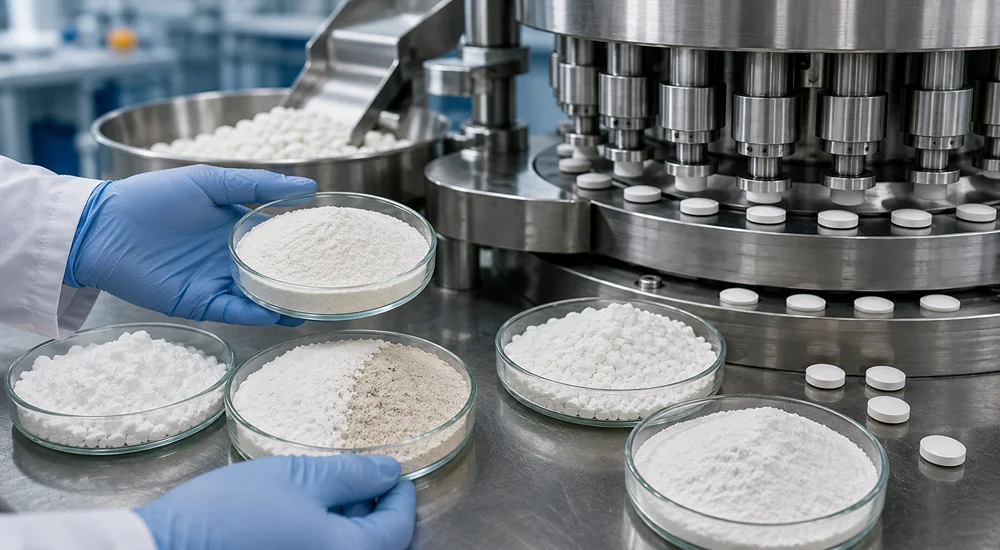
The direct compression of tablets is one of the most preferred manufacturing methods in the pharmaceutical industry. It is fast, cost-effective, and eliminates several processing steps involved in wet granulation. Because of its efficiency, many manufacturers rely on direct compression to simplify production and improve scalability.
However, despite its advantages, direct compression is not always as straightforward as it seems. Many formulations fail during compression due to poor powder behavior, unsuitable API characteristics, inconsistent excipient performance, or formulation imbalance. Problems such as capping, weight variation, sticking, and weak tablet hardness are commonly linked to excipient-related issues.
In most cases, the problem is not the process itself, it is the way excipients are selected and used within the formulation.
Why Direct Compression Is Widely Used in Tablet Manufacturing
Direct compression involves compressing powders directly into tablets without the need for granulation. This reduces processing time, lowers manufacturing costs, and minimizes exposure to moisture and heat.
The process is especially useful for:
- Moisture-sensitive formulations
- Heat-sensitive active ingredients
- High-speed pharmaceutical manufacturing
Despite these advantages, the success of direct compression depends heavily on the physical properties of the powder blend. Since there are fewer processing steps to compensate for poor material behavior, excipient performance becomes critical.
Mistake 1: Choosing Excipients With Poor Flow Properties
Flowability is one of the most important requirements in direct compression formulations. Powders must flow uniformly into the die cavity during tablet compression. If flow properties are poor, inconsistent die filling can occur, leading to tablet weight variation and dosage inconsistency.
Some common causes of poor flow include:
- Fine particle size
- Irregular particle shape
- High cohesiveness
- Inadequate bulk density
This is where excipients such as microcrystalline cellulose play an important role. Certain grades of MCC are specifically designed to improve powder flow while maintaining good compressibility.
How to Avoid This Problem
Manufacturers should carefully evaluate powder flow characteristics before finalizing the formulation. Selecting excipients with stable flow properties can significantly improve manufacturing consistency. In addition to selecting highly compressible excipients, manufacturers should carefully optimize lubricant levels during formulation development. Excessive lubrication or prolonged blending can reduce particle bonding, resulting in softer tablets and inconsistent performance. Evaluating lubricant concentration and mixing time during formulation trials helps maintain tablet strength while ensuring smooth compression.
Mistake 2: Ignoring Compressibility Requirements
Compressibility refers to the ability of powder particles to form strong tablets under compression. Poor compressibility is one of the leading causes of direct compression failure.
When compressibility is inadequate, manufacturers may encounter:
- Weak tablets
- Capping and lamination
- Tablet cracking
- Hardness inconsistency
In the direct compression of tablets, excipients must provide enough binding strength to maintain tablet integrity without requiring additional processing steps.
How to Avoid This Problem
Using excipients known for strong compressibility, such as microcrystalline cellulose, helps create robust tablets with improved structural stability. Formulation trials should also evaluate compression behavior under different manufacturing conditions.
Mistake 3: Using Inconsistent Excipient Grades
Not all excipient grades behave the same way. Variations in particle size distribution, density, and moisture content can significantly impact formulation performance.
Many manufacturers overlook how differences between excipient grades affect:
- Powder flow
- Compression behavior
- Blend uniformity
- Batch consistency
For example, different grades of microcrystalline cellulose are designed for specific formulation requirements. Choosing an unsuitable grade can increase the risk of tablet defects and process instability.
How to Avoid This Problem
It is important to select excipient grades based on formulation needs rather than availability alone. Consistent excipient quality and controlled physical properties are essential for reliable direct compression performance.
Mistake 4: Overlooking Moisture Sensitivity
Moisture plays a major role in tablet formulation behavior. Excess or insufficient moisture can adversely affect powder flow, compressibility, tablet strength, and overall tablet quality.
Some excipients are highly sensitive to environmental conditions, making moisture control critical during manufacturing and storage.
In direct compression formulations, moisture imbalance can contribute to:
- Tablet sticking
- Surface defects
- Hardness variation
- Reduced stability
How to Avoid This Problem
Manufacturers should maintain controlled environmental conditions and use excipients with stable moisture behavior. Proper packaging and storage conditions also help maintain formulation consistency.
How Excipients Influence Direct Compression Success
The success of direct compression depends largely on the functionality of excipients within the formulation. Unlike granulation processes, direct compression provides limited opportunities to correct poor powder behavior during manufacturing.
Excipients help support:
- Powder flow
- Compressibility
- Blend uniformity
- Tablet hardness
- Manufacturing efficiency
Among the most widely used excipients in direct compression formulations is microcrystalline cellulose, valued for its balance of compressibility and flow properties.
Proper excipient selection allows manufacturers to achieve smoother processing and more stable tablet production.
Why Excipient Quality Matters in Direct Compression
Even when the correct excipient type is selected, quality consistency remains critical. Variations in raw material properties can create unpredictable behavior during compression.
Important excipient characteristics include:
- Particle size consistency
- Moisture control
- Bulk density
- Flow properties
Reliable excipient quality reduces formulation variability and supports consistent tablet performance across production batches.
Best Practices for Improving Direct Compression Performance
Manufacturers can improve direct compression outcomes by focusing on both formulation design and process control.
Key practices include:
- Selecting excipients with proven direct compression performance
- Evaluating powder flow and compressibility during development
- Maintaining controlled environmental conditions
- Monitoring compression parameters regularly
- Using consistent raw material sources
These steps help reduce manufacturing issues and improve overall tablet quality.
Conclusion
The direct compression of tablets offers significant advantages in pharmaceutical manufacturing, but its success depends heavily on excipient functionality and formulation design. Problems such as poor flow, weak compressibility, inconsistent excipient grades, and moisture sensitivity can all contribute to manufacturing failures.
Understanding these common mistakes allows formulation teams to make better decisions during product development and scale-up. High-quality excipients with controlled physical properties play a major role in achieving stable, efficient, and reliable direct compression formulations.
With extensive expertise in cellulose-based excipients, Ankit Pulps & Boards Pvt. Ltd. supports pharmaceutical manufacturers with reliable microcrystalline cellulose solutions designed for direct compression applications and consistent tablet manufacturing performance.
Frequently Asked Questions
What is direct compression of tablets?
Direct compression is a tablet manufacturing process where powders are compressed directly into tablets without granulation.
What causes direct compression to fail?
Direct compression failures are often caused by poor powder flow, inadequate compressibility, inconsistent excipient quality, and moisture imbalance.
Why is microcrystalline cellulose used in direct compression?
Microcrystalline cellulose is widely used because it offers excellent compressibility, stable flow properties, and reliable tablet formation.
What are common problems in direct compression tablets?
Common problems include capping, lamination, sticking, weight variation, and poor tablet hardness.
How can direct compression tablet defects be reduced?
Defects can be minimized by selecting suitable excipients, optimizing formulation design, and maintaining proper process control.
Why are excipients important in direct compression formulations?
Excipients support powder flow, compressibility, and blend uniformity, all of which are essential for successful tablet compression.