Consumer demand for healthier food options has grown significantly over the last decade. More people are looking for products with reduced fat content while still expecting the same taste, texture, and overall eating experience. For food manufacturers, meeting these expectations is often challenging because fat contributes much more than just calories. It plays a key role in texture, mouthfeel, stability, and product consistency.
This is where microcrystalline cellulose in low-fat food products becomes valuable. Often misunderstood as simply a filler, microcrystalline cellulose (MCC) serves multiple functional purposes in food formulations. It helps manufacturers create reduced-fat products that maintain desirable texture and quality without compromising consumer expectations.
What Is Microcrystalline Cellulose?
Microcrystalline cellulose is a purified form of cellulose derived from plant-based sources. It is widely used across pharmaceutical, food, and industrial applications because of its excellent functional properties.
In the food industry, food grade microcrystalline cellulose is commonly used as a texturizer, stabilizer, bulking agent, and fat replacer. It is valued for its ability to improve product structure while remaining neutral in taste and odor.
Unlike many other ingredients, MCC does not significantly alter flavor profiles, making it a versatile option for a wide range of food applications.
Why Fat Reduction Creates Formulation Challenges
Reducing fat in food products is not as simple as removing an ingredient. Fat contributes to several important characteristics that consumers associate with quality.
Fat helps provide:
- Creamy texture
- Smooth mouthfeel
- Product stability
- Richness and body
- Moisture retention
When fat levels are reduced, products can become dry, watery, grainy, or less satisfying to consume. These challenges often require manufacturers to find alternative ingredients that can replicate some of fat’s functional properties.
This is one reason why microcrystalline cellulose in food has become increasingly popular in modern food formulation.
How Microcrystalline Cellulose Functions in Low-Fat Food Products
One of the biggest advantages of MCC is its ability to support product structure and texture. When properly incorporated into formulations, MCC can help form a structural network within certain formulations that supports water retention and improves consistency. This network contributes to a fuller mouthfeel and helps compensate for the absence of fat. As a result, manufacturers can reduce fat content while maintaining the sensory qualities consumers expect.
Texture Enhancement
Texture is often the first characteristic affected when fat is reduced.
Microcrystalline cellulose helps create a smooth and uniform structure that enhances the overall eating experience. By improving product body and consistency, MCC supports the development of low-fat foods that remain appealing to consumers.
For products such as dairy formulations, sauces, and dressings, texture improvement is one of the primary reasons MCC is selected.
Mouthfeel Improvement
Consumers expect reduced-fat products to feel similar to their full-fat counterparts.
As a functional ingredient, MCC helps improve mouthfeel by providing volume and structure within the formulation. This contributes to a richer and more satisfying sensory experience, making low-fat products more acceptable to consumers.
Moisture Retention
Low-fat products often struggle with dryness and reduced shelf-life stability.
MCC helps retain water within the food matrix through its water-holding capacity. This can improve product freshness and contribute to a more desirable texture throughout storage.
Stability Support
Many food products require stable emulsions and consistent ingredient distribution.
MCC helps improve physical stability by reducing phase separation and maintaining a more uniform dispersion. This is particularly important in liquid and semi-solid food systems where stability directly affects product quality.
Microcrystalline Cellulose as a Fat Replacer
One of the most important applications of MCC is its role as a fat replacer in food products.
While MCC does not replace fat chemically, it helps replicate several functional properties that fat provides. By contributing texture, body, and moisture management, MCC enables manufacturers to reduce fat content without dramatically changing the consumer experience.
As demand for healthier products continues to grow, food manufacturers increasingly rely on ingredients that can deliver both nutritional and functional benefits.
Food Products That Commonly Use MCC
The versatility of MCC makes it suitable for a wide range of applications.
Some common examples include:
Low-Fat Cheese Products
MCC is often used to help maintain texture and structural integrity in reduced-fat cheese formulations.
Dairy Products
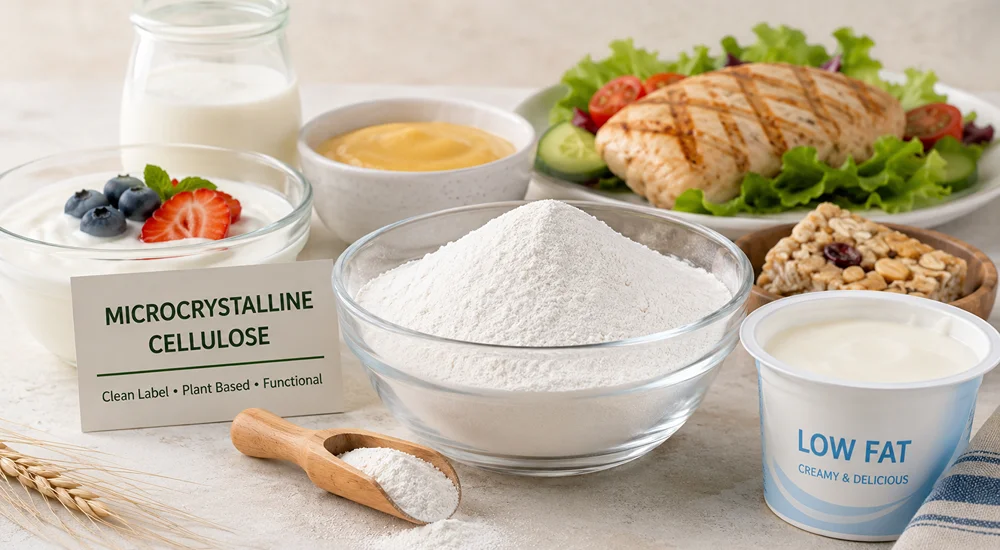
Yogurts and dairy-based desserts may utilize MCC to improve consistency and mouthfeel.
Sauces and Dressings
In sauces and dressings, MCC contributes to stability while helping maintain a smooth texture.
Bakery Products
Reduced-fat bakery products can benefit from improved moisture retention and texture enhancement.
Frozen Desserts
Frozen desserts may use MCC to improve body, stability, and resistance to ice crystal-related texture changes.
These applications demonstrate why microcrystalline cellulose food applications continue to expand across multiple food categories.
Benefits of Using Food Grade Microcrystalline Cellulose
Food manufacturers choose MCC for several reasons beyond fat reduction.
Some key advantages include:
- Improved texture and mouthfeel
- Better moisture management
- Enhanced formulation stability
- Neutral flavor profile
- Versatility across food categories
- Consistent performance during processing
These benefits help manufacturers create products that align with evolving consumer preferences for healthier food choices.
Why Food Manufacturers Continue to Choose MCC
As the food industry continues to innovate, ingredient functionality becomes increasingly important. Manufacturers need ingredients that not only support nutritional goals but also maintain product quality.
Food grade microcrystalline cellulose offers a practical solution because it addresses several formulation challenges simultaneously. Its ability to improve texture, support stability, and function as a fat replacer makes it a valuable ingredient in modern food development.
With growing demand for reduced-fat foods, MCC is likely to remain an important component of future food formulations.
Conclusion
The role of microcrystalline cellulose in low-fat food products extends far beyond that of a simple filler. It serves as a multifunctional ingredient that helps improve texture, mouthfeel, moisture retention, and stability in reduced-fat formulations. By supporting these critical product attributes, MCC enables manufacturers to develop healthier food options without sacrificing quality or consumer satisfaction.
As a trusted manufacturer of cellulose-based ingredients, Ankit Pulps & Boards Pvt. Ltd. provides high-quality food grade microcrystalline cellulose solutions designed to support evolving food formulation needs. Through consistent quality and advanced manufacturing practices, the company continues to help food manufacturers create innovative products that meet modern consumer expectations.
Frequently Asked Questions
What is microcrystalline cellulose used for in low-fat food products?
Microcrystalline cellulose is used to improve texture, mouthfeel, stability, and moisture retention in low-fat food formulations.
Is microcrystalline cellulose a fat replacer?
MCC is commonly used as part of fat-reduction systems because it helps mimic several functional properties of fat, such as texture, body, and mouthfeel.
Why is microcrystalline cellulose used in food formulations?
It helps improve product consistency, enhance texture, support stability, and maintain overall product quality.
What are the benefits of food grade microcrystalline cellulose?
Benefits include texture improvement, moisture retention, formulation stability, neutral taste, and versatility across different food applications.
Which food products commonly contain microcrystalline cellulose?
Microcrystalline cellulose is commonly used in low-fat cheese, dairy products, sauces, dressings, bakery products, and frozen desserts.
Is microcrystalline cellulose safe for food use?
Food grade microcrystalline cellulose is widely used in food manufacturing and is recognized for its functional benefits in various food applications.