When we think about medicines, the focus usually stays on the active ingredient, the one responsible for the therapeutic effect. But behind every effective formulation, there is a carefully selected set of supporting ingredients known as excipients. These components may not deliver the primary effect, but they play a crucial role in ensuring the product performs as intended.
In many formulations, product performance depends significantly on how pharmaceutical excipients are selected and combined. From stability and manufacturability to consistency and performance, excipients influence nearly every aspect of the final product.
What Are Excipients in Pharmaceuticals?
Excipients are inactive substances used in drug formulations to support the active pharmaceutical ingredient (API). They support processing, stability, delivery, and overall product performance.
In simple terms, excipients act as the foundation of a formulation. Without them, producing stable and consistent dosage forms would be significantly more challenging.
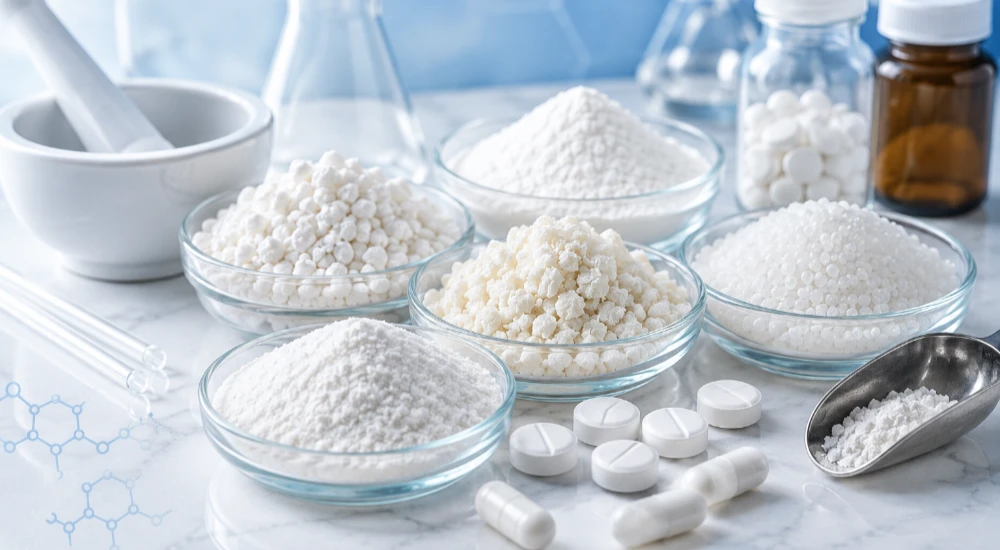
Common examples of pharmaceutical excipients include fillers, binders, disintegrants, lubricants, and coatings. Each type of excipient serves a specific function, contributing to the overall behavior of the product.
Why Excipients Matter More Than You Think
It’s easy to underestimate the importance of excipients, but their impact is significant. Even small variations in excipient properties can lead to noticeable differences in formulation performance.
For instance, excipients influence:
- Tablet hardness and strength
- Stability and shelf life
- Uniformity of dosage
- Manufacturing efficiency
If the excipient system is not optimized, it can lead to issues such as poor compressibility, inconsistent flow, or formulation performance issues. This is why selecting the right excipients in pharmaceutical products is a critical step in formulation development.
Key Functions of Pharmaceutical Excipients
Different excipients perform different roles in a formulation. Understanding these functions helps in designing a stable and effective product.
1. Fillers (Diluents)
Fillers add bulk to the formulation, making it easier to handle and process. Materials like microcrystalline cellulose are commonly used to create a uniform structure.
2. Binders
Binders help hold the formulation together, ensuring that tablets maintain their shape and strength.
3. Disintegrants
Disintegrants allow tablets to break down properly, supporting the release of the active ingredient.
4. Lubricants
Lubricants reduce friction during manufacturing, improving process efficiency and preventing sticking issues.
Each of these pharmaceutical excipients contributes to both product quality and manufacturing performance.
How Excipients Impact Final Product Performance
The role of excipients goes beyond basic functionality, they influence formulation behavior during manufacturing, storage, and use.
A well-designed excipient system supports:
- Consistent product quality across batches
- Stable formulation during storage
- Smooth manufacturing processes
- Reliable performance during use
On the other hand, poor excipient selection can lead to formulation instability, production delays, or quality issues. This is why excipient performance is often considered a key factor in successful product development.
Common Challenges Related to Excipients
Formulation teams often face challenges when working with excipients, especially when scaling production.
Some common issues include:
- Variability in raw material properties
- Poor flow behavior
- Inconsistent compressibility
- Compatibility issues with APIs
These challenges highlight the importance of choosing high-quality excipients and working with reliable suppliers who maintain consistent manufacturing standards.
How to Choose the Right Excipients for Your Formulation
Selecting the right excipients requires a clear understanding of formulation requirements and processing conditions.
Key factors to consider include:
- Compatibility with the active ingredient
- Desired product characteristics
- Manufacturing method
- Regulatory requirements
Testing different combinations during development can help evaluate the most suitable excipient system for a specific application.
The Role of Quality in Pharmaceutical Excipients
Quality consistency is one of the most important aspects of excipient selection. Even if the right type of excipient is chosen, variations in quality can affect formulation consistency.
High-quality pharmaceutical excipients offer:
- Controlled particle size
- Consistent performance
- Reliable flow and compressibility
- Stable formulation behavior
This consistency helps maintain predictable formulation performance across production batches.
Conclusion
Excipients may be termed inactive ingredients, but their impact on formulation success is anything but minor. From ensuring structural integrity and stability to supporting efficient manufacturing and consistent product performance, pharmaceutical excipients play an important role in the quality and consistency of the final product. Even small variations in excipient properties can influence outcomes, making careful selection and consistency essential.
With a strong foundation in cellulose-based excipients and a focus on controlled manufacturing processes, Ankit Pulps & Boards Pvt. Ltd. supports pharmaceutical manufacturers with reliable, high-quality excipient solutions. By maintaining consistent product standards and performance across batches, supporting formulators in developing stable and scalable formulations meet evolving industry requirements.