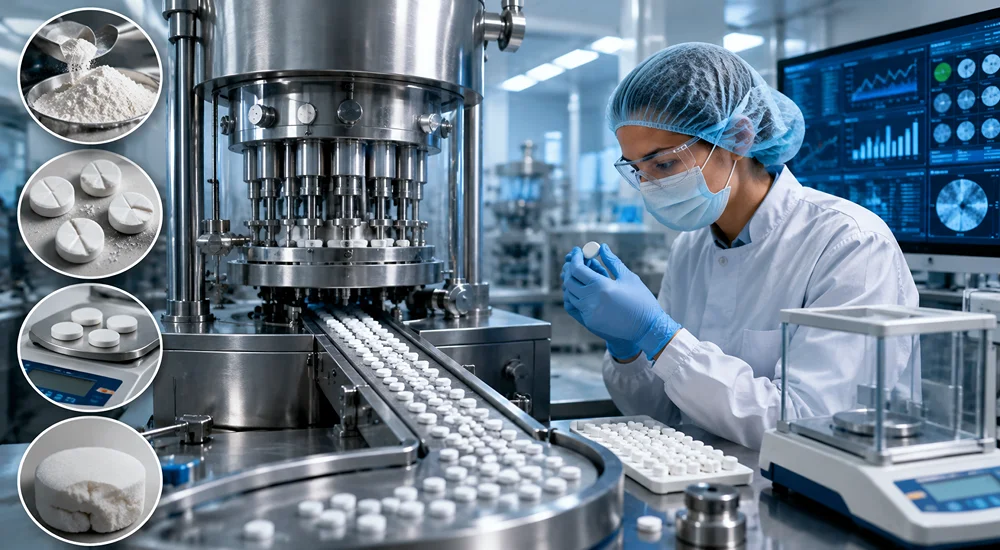
Tablet manufacturing is one of the most widely used production methods in the pharmaceutical industry. Tablets are convenient, stable, easy to transport, and cost-effective to produce at scale. However, behind every successful tablet formulation lies a highly controlled manufacturing process where even small variations can create significant production challenges.
From powder flow issues to tablet defects and batch inconsistency, manufacturers regularly face problems that can impact product quality, production efficiency, and regulatory compliance. Understanding these tablet manufacturing challenges is essential for developing reliable formulations and maintaining consistent product performance.
Why Tablet Manufacturing Requires Precision
At first glance, tablet manufacturing may appear straightforward. Ingredients are blended, compressed, and packaged. But in reality, the process involves a delicate balance between formulation design, raw material behavior, equipment settings, and environmental conditions.
Every component within the formulation must perform consistently throughout blending, granulation, compression, and storage. Even slight changes in powder properties or process parameters can lead to defects that affect the final product.
This is why pharmaceutical companies place significant emphasis on formulation optimization, process control, and excipient selection during tablet development.
Common Tablet Manufacturing Challenges
Several issues can arise during tablet manufacturing, particularly when formulations are scaled for commercial production. Some challenges are visible in the final tablet appearance, while others affect internal product performance.
Poor Powder Flow
Powder flow is one of the most common problems in tablet manufacturing. If powders do not flow consistently through the equipment, it can lead to uneven die filling and weight variation between tablets.
Flow issues are often linked to:
- Fine particle size
- Poor bulk density
- Inconsistent material properties
- Poor flowability due to high cohesiveness
Excipients such as microcrystalline cellulose are frequently used to improve flowability, compressibility, and blend uniformity during tablet manufacture.
Capping and Lamination
Capping occurs when the top or bottom portion of a tablet separates after compression, while lamination refers to tablets splitting into layers. These problems are commonly associated with air entrapment, poor compressibility, or insufficient binder strength.
Such defects not only affect appearance but can also compromise tablet integrity and stability.
Sticking and Picking
Sticking happens when formulation material adheres to tablet punches during compression. Picking is a similar issue where material sticks to engraved areas of the tooling.
These problems are often caused by:
- Excess moisture
- Inadequate lubrication
- Improper formulation balance
Manufacturers must carefully control moisture levels and excipient selection to minimize these issues.
Tablet Hardness Variability
Maintaining the right tablet hardness is essential. Tablets that are too soft may break during handling, while overly hard tablets may fail to disintegrate properly.
Hardness variability can result from:
- Incorrect compression force
- Uneven particle distribution
- Inconsistent excipient performance
Achieving the right balance requires careful formulation optimization and process monitoring.
Batch-to-Batch Inconsistency
Consistency across production batches is one of the biggest concerns in pharmaceutical manufacturing. Variations in raw material properties, environmental conditions, or process settings can lead to inconsistent tablet quality.
This challenge highlights the importance of using reliable raw materials and maintaining strict quality control systems throughout production.
How Excipients Influence Tablet Manufacturing
Excipients are often called inactive ingredients, but their role in tablet manufacturing is highly significant. They directly influence compressibility, flow behavior, stability, and overall manufacturing efficiency.
Different types of excipients serve different purposes within the formulation.
Fillers and Diluents
Fillers provide bulk and help create a uniform tablet structure. Microcrystalline cellulose is one of the most widely used pharmaceutical excipients because of its excellent compressibility, binding properties, and consistent performance during direct compression processes. It also supports better powder flow and helps maintain uniformity across production batches.
Binders
Binders help hold formulation particles together, improving tablet strength and reducing cracking or chipping. Proper binder selection also enhances tablet durability during handling, packaging, and transportation.
Disintegrants
Disintegrants help tablets break down properly after administration, supporting consistent product performance. They play an important role in ensuring uniform disintegration and maintaining formulation reliability.
Lubricants
Lubricants reduce friction during compression and improve smooth tablet ejection from dies. They also help minimize sticking issues and reduce wear on manufacturing equipment during high-speed production.
The correct balance of excipients can significantly reduce tablet manufacturing challenges and improve product consistency. Carefully selected excipients also contribute to smoother processing and more stable tablet performance throughout the product lifecycle.
The Importance of Raw Material Quality
One critical factor in tablet manufacturing is the quality consistency of raw materials. Even when the formulation design is correct, variations in excipient properties can impact production outcomes.
Important excipient characteristics include:
- Particle size distribution
- Moisture content
- Bulk density
- Compressibility
Reliable excipient quality helps maintain predictable manufacturing behavior and reduces the risk of formulation variability.
Process Optimization in Tablet Manufacturing
In addition to formulation design, process optimization plays a major role in preventing manufacturing problems.
Manufacturers typically focus on:
- Compression force control
- Granulation parameters
- Environmental monitoring
- Equipment calibration
- Process validation
These controls help maintain consistency and minimize the occurrence of defects during large-scale production.
Why Solving Tablet Manufacturing Challenges Matters
Addressing tablet manufacturing challenges is not only important for operational efficiency but also for ensuring patient safety and regulatory compliance.
Poorly manufactured tablets can lead to:
- Inconsistent dosage
- Reduced stability
- Product recalls
- Increased production costs
By improving formulation design and selecting high-quality excipients, manufacturers can reduce production risks and improve overall product reliability.
Conclusion
Tablet manufacturing is a highly controlled process where formulation behavior, excipient performance, and process conditions must work together seamlessly. Challenges such as poor powder flow, capping, sticking, and batch inconsistency can significantly affect product quality and manufacturing efficiency.
Understanding these issues and addressing them through proper formulation strategies is essential for achieving reliable pharmaceutical production. High-quality excipients, controlled manufacturing processes, and consistent raw material performance all contribute to minimizing variability and improving tablet quality.
With extensive experience in cellulose-based excipients, Ankit Pulps & Boards Pvt. Ltd. supports pharmaceutical manufacturers with reliable microcrystalline cellulose solutions designed to support consistent formulation performance and efficient pharmaceutical manufacturing.
Frequently Asked Questions
What are the most common tablet manufacturing challenges?
Common tablet manufacturing challenges include poor powder flow, capping, sticking, hardness variation, and batch inconsistency.
Why is powder flow important in tablet manufacturing?
Proper powder flow ensures uniform die filling, which helps maintain consistent tablet weight and dosage accuracy.
How do excipients help in tablet manufacturing?
Excipients improve compressibility, flow properties, tablet strength, and manufacturing efficiency within pharmaceutical formulations.
What causes capping and lamination in tablets?
Capping and lamination are often caused by air entrapment, poor compressibility, or incorrect compression settings during tablet production.
Why is raw material consistency important in tablet manufacturing?
Consistent raw material quality helps maintain predictable formulation behavior and reduces variability across production batches.
How can tablet manufacturing problems be reduced?
Tablet manufacturing issues can be minimized through proper formulation design, high-quality excipients, process optimization, and regular quality control checks.